A Summer’s End – Hong Kong, 1986
Play A Summer’s End – Hong Kong, 1986
A Summer’s End – Hong Kong, 1986 Screenshots







A Summer’s End – Hong Kong, 1986 review
A candid look at how A Summer’s End blends adult content, queer romance, and emotional storytelling
A Summer’s End – Hong Kong, 1986 is often searched alongside adult-focused terms, which can be confusing if you have only seen screenshots of its neon-soaked streets and tender moments between Michelle and Sam. Underneath the vaporwave glow, this visual novel is first and foremost a queer love story that happens to offer an optional adult patch, not an explicit-first experience. In this article, I want to share what I learned when I played it expecting a racy title and instead found a slow-burn romance about identity, culture, and desire in 1980s Hong Kong — and how the intimate scenes actually deepen that story instead of defining it.
What Is A Summer’s End – Hong Kong, 1986 Really About?
Let’s be honest for a second. When you hear a game has an “adult patch,” what’s the first thing that comes to mind? 😏 I’ll admit, when I first stumbled upon A Summer’s End – Hong Kong, 1986, that was my assumption too. The store tags, the evocative art—my brain immediately filed it under a very specific category. I settled in expecting one kind of experience, but what I got was something entirely different, and honestly, so much better.
This isn’t a criticism of those kinds of games, but a clarification. A Summer’s End – Hong Kong, 1986 is, at its beating heart, a beautifully crafted queer romance game. The intimacy is there, but it serves the story, not the other way around. It’s a visual novel where the plot isn’t a vehicle for scenes, but where moments of closeness are a punctuation mark in a much larger, more emotional sentence.
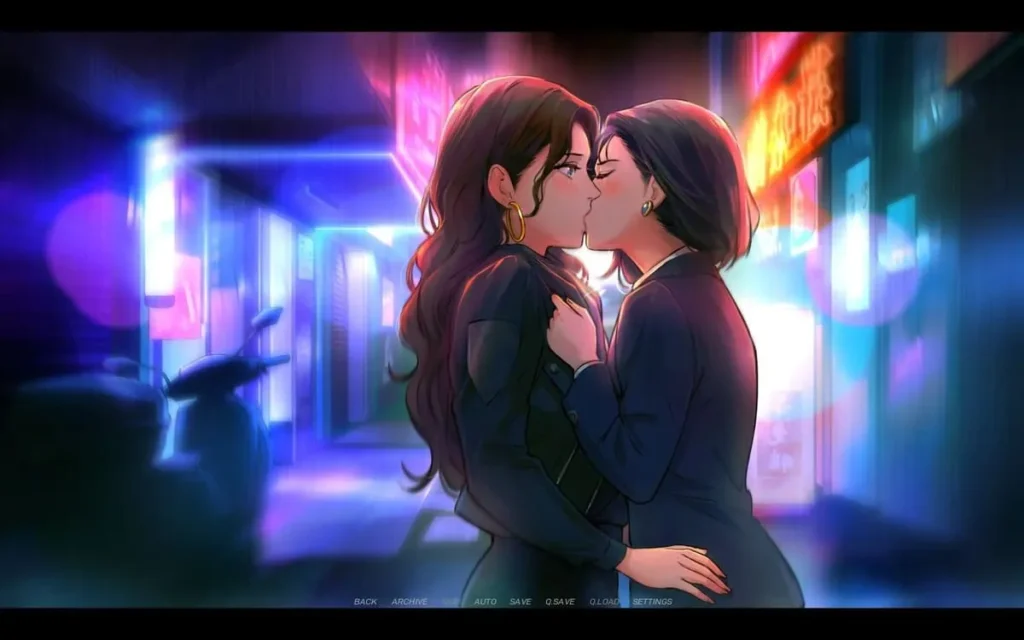
So, what is it really about? It’s about two women, Michelle and Sam, finding each other in a specific, shimmering moment in time. It’s about the A Summer’s End story of identity, family duty, and the terrifying, exhilarating leap toward your true self. The Hong Kong 1986 setting isn’t just a backdrop; it’s a character in itself, all neon signs, bustling markets, and the weight of tradition hanging in the humid air. If you’re coming here looking for a certain type of adult game, you might be surprised. But if you’re looking for a romance that feels real, raw, and wonderfully specific, you’re in the right place.
A queer romance set in 1980s Hong Kong, not an explicit-first title
This is the most important point to grasp, and it redefines the entire experience. A Summer’s End visual novel is a narrative-first, character-driven journey. Think of it less like a titillating romp and more like a heartfelt, cinematic indie film where the central relationship happens to be queer. The game’s primary goal is to make you care deeply about Michelle and Sam, to feel the stakes of their connection, and to understand the world they’re navigating.
The so-called “adult” content exists in an optional patch for a reason. It’s not the core product. When enabled, these scenes are woven into the narrative at key emotional junctures. They are extensions of the characters’ vulnerability and growing intimacy, not isolated events. The game spends far more time on conversations over noodles, tense family dinners, and walks through the city than anything else. The emotional storytelling is the main course; everything else is seasoning.
The developers, Oracle & Bone, have been clear that their mission was to tell a specific story about queer Asian women, a perspective still rare in games. Every choice—from the stunning, anime-inspired art drenched in 80s aesthetics to the killer synthwave soundtrack—is in service to that queer romance and its authentic atmosphere. Labeling this primarily as an A Summer’s End adult game is like calling Call Me By Your Name a food film because there are scenes of eating. It misses the profound point entirely. 🎬
Michelle and Sam’s story: office life, neon nights, and family tension
Now, let’s meet our protagonists. Michelle is someone I immediately related to. She’s in her twenties, working a respectable but uninspiring office job, and shouldering the quiet expectations of her traditional family. Her life is a series of routines, defined by filial duty and a lingering uncertainty about who she is supposed to be. She’s pragmatic, a little reserved, and living a life that feels more like a script she hasn’t fully agreed to.
Enter Sam. 🕶️ She’s a breath of fresh, rebellious air. More confident, openly queer, and living a less conventional life, she represents everything Michelle’s world is not: freedom, self-expression, and authenticity. Their meet-cute isn’t in a club, but in a mundane supermarket—a perfect metaphor for how unexpected and ordinary the start of something extraordinary can be.
Their relationship develops through a series of encounters that perfectly capture the Hong Kong 1986 setting. They share drinks in neon-lit bars, go to the cinema (a wonderfully meta touch, given the game’s love for 80s Hong Kong cinema), and wander through the vibrant chaos of places like Mong Kok. These aren’t just dates; they’re explorations of a city—and a self—that Michelle is seeing through new eyes.
The real tension in the A Summer’s End story isn’t just “will they or won’t they?” It’s “can Michelle reconcile the life she’s known with the person she’s becoming?”
The family pressure on Michelle is palpable and forms the central conflict. You feel the weight of her mother’s expectations, the unspoken rules, and the fear of disappointment. This is where the game’s brilliance shines: the romance with Sam is sweet and compelling, but the true drama is internal, within Michelle’s own heart and mind.
This brings us to the A Summer’s End endings. Your choices throughout the game, often subtle shifts in dialogue or attitude, don’t just determine “good” or “bad” romance outcomes. They chart the course of Michelle’s personal journey. The two main endings reflect a fundamental choice: one toward the safety and conformity of her old life, and the other toward the risky, uncertain, but authentic future with Sam. Neither is painted as purely right or wrong, which is what makes the emotional impact so resonant.
Here’s where my personal anecdote fits. I went in after seeing certain tags, my guard up, ready for a certain pace. What I found instead was a slow, beautiful burn. I was genuinely on the edge of my seat during a tense family lunch, my heart aching during a moment of quiet doubt from Michelle, and cheering during a small act of rebellion. The moments of physical intimacy, when they came, felt earned—a natural culmination of the emotional bond I’d been invested in for hours. I wasn’t just a spectator to a romance; I was a companion on Michelle’s journey of self-discovery. 💖
Why people label A Summer’s End – Hong Kong, 1986 as an adult game
This is a fair question, and the reasons are more about digital storefront logistics and surface-level impressions than the game’s true soul. Let’s break it down, because understanding this helps set the right expectations.
First, there’s the optional adult patch. The mere existence of this patch gets the game tagged with certain keywords on distribution platforms. Algorithms and store filters then lump it in with titles where that content is the primary focus. For someone browsing quickly, “Visual Novel + Adult Patch” can create a specific, and often misleading, first impression.
Second, marketing and visuals play a huge role. The key art for A Summer’s End – Hong Kong, 1986 is stunning and sensual. It features Michelle and Sam in close, intimate poses, drenched in that gorgeous neon glow. It captures a feeling—of desire, heat, and connection—which is absolutely true to the game’s atmosphere. However, in a crowded marketplace, these visuals can emphasize the romantic and physical chemistry over the nuanced, dialogue-heavy narrative that makes up 90% of the playtime.
Finally, there’s the player expectation and search habit. People looking for games with queer female romance still often have to wade through tags like “adult” to find what they want. Conversely, people using “adult game” as a search term will inevitably find this title because of its patch and tags. It creates a cycle where the label sticks, even if it’s an imperfect fit.
Think of it this way:
| If You’re Expecting This (A Typical “Adult Game”)… | You’ll Find This in A Summer’s End… |
|---|---|
| Fast-paced plot leading to intimate scenes | A slow-burn, narrative-driven character study |
| Gameplay focused on choices that directly trigger content | Choices that shape personality, relationship tone, and ultimate life direction |
| Minimal plot or character development between scenes | Rich, immersive world-building and deep emotional connections between characters |
| The explicit content as the primary goal and reward | Intimacy as one narrative element among many (supporting the romance) |
The takeaway? A Summer’s End – Hong Kong, 1986 is caught between two audiences. It uses tools (like an adult patch) and aesthetics that attract one crowd, while its heart and soul belong firmly to another. It’s a queer romance game first, last, and always, but you might need to look past the digital storefront’s classification to see it.
So, who is this game for? It’s for the player who loves a good story, who wants to sink into a specific time and place, and who cherishes complex character dynamics over straightforward titillation. It’s a poignant, beautiful experience about love and self-discovery that just happens to include mature themes. And that’s what makes it so special. ✨
FAQ: Setting the Record Straight
Q: So, is A Summer’s End – Hong Kong, 1986 mainly an adult game or a romance visual novel?
A: Without question, it is primarily a romance visual novel. The core experience is the emotional storytelling and the development of the relationship between Michelle and Sam within the vibrant Hong Kong 1986 setting. The adult content is optional and narrative-integrated, serving to enhance the romantic arc rather than define it.
Q: Will I enjoy it if I usually play games focused on explicit content?
A: It depends on what you’re looking for. If you prioritize plot, character, and emotional payoff over frequent explicit scenes, you might be pleasantly surprised by the depth here. However, if you are seeking a game where that content is the central and frequent focus, the pacing and story-heavy nature of A Summer’s End might not meet those expectations.
Q: I love romance stories but am wary of overly explicit games. Is this for me?
A: Absolutely. You can play the entire game without the adult patch and experience a complete, rich, and profoundly moving queer romance game. The patch adds a layer of intimacy for those who want it, but the story’s power—the family tension, the personal growth, the A Summer’s End endings—is entirely intact without it.
Q: How important is the 1980s Hong Kong setting?
A: It’s crucial. It’s not just a cool aesthetic; it directly influences the story’s conflict. The societal expectations, the fashion, the music, and the cinematic vibe all create the pressure cooker in which Michelle and Sam’s relationship unfolds. The setting makes the A Summer’s End story uniquely compelling.
By the time the credits rolled on A Summer’s End – Hong Kong, 1986, I realised I hadn’t just played through a stylish visual novel, I’d sat with a quiet, determined love story about two women trying to claim space for themselves in a city that doesn’t always make that easy. The optional adult content is there, but it exists to underline a relationship that has already been built through glances, conversations, and difficult choices. If you come in knowing that this is a character-driven queer romance first and an adult experience second, you’re far more likely to appreciate what it’s doing. If that mix of neon nostalgia, emotional storytelling, and carefully handled intimacy sounds like your kind of evening, A Summer’s End – Hong Kong, 1986 is absolutely worth sitting down with and seeing where Michelle and Sam’s summer takes you.